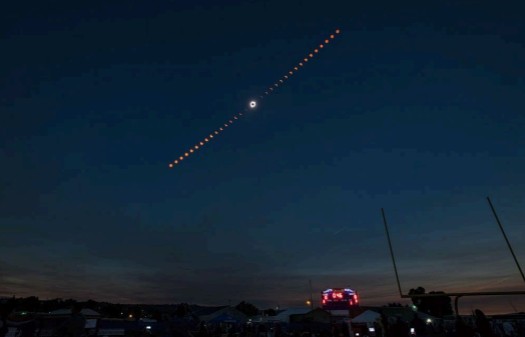
During a solar eclipse, the sky slowly gets darker because the moon moves
infront of the sun! In this activity you will programme your micro:bit to measure
how bright it is and save that data so you can look at it as a graph afterwards.
Micro:bits make this really easy! The tiny lights on your micro:bit (called LEDs) can
also work the other way around and detect light, not just make it. So your
micro:bit already has a light sensor built in – no extra parts needed!
As well as using coding to measure eclipses, we use the same types of programs
to monitor the environment in our computer rooms and laboratories. It’s
important to keep all our scientists, computer scientists, engineers and
technicians safe, as well as to understand the results of our experiments!
If you don’t have a micro:bit, you can still do the coding for yourself, simulate
what an eclipse might look like using the micro:bit simulator in MakeCode, and
look at the data collected!